Tertiary Crusher for Iron Ore & Minerals: Benefits, Costs & Production Capacity
Tertiary crushers represent the final stage in mineral processing circuits, delivering precision-sized products that meet strict quality specifications while maximizing operational efficiency and profitability.
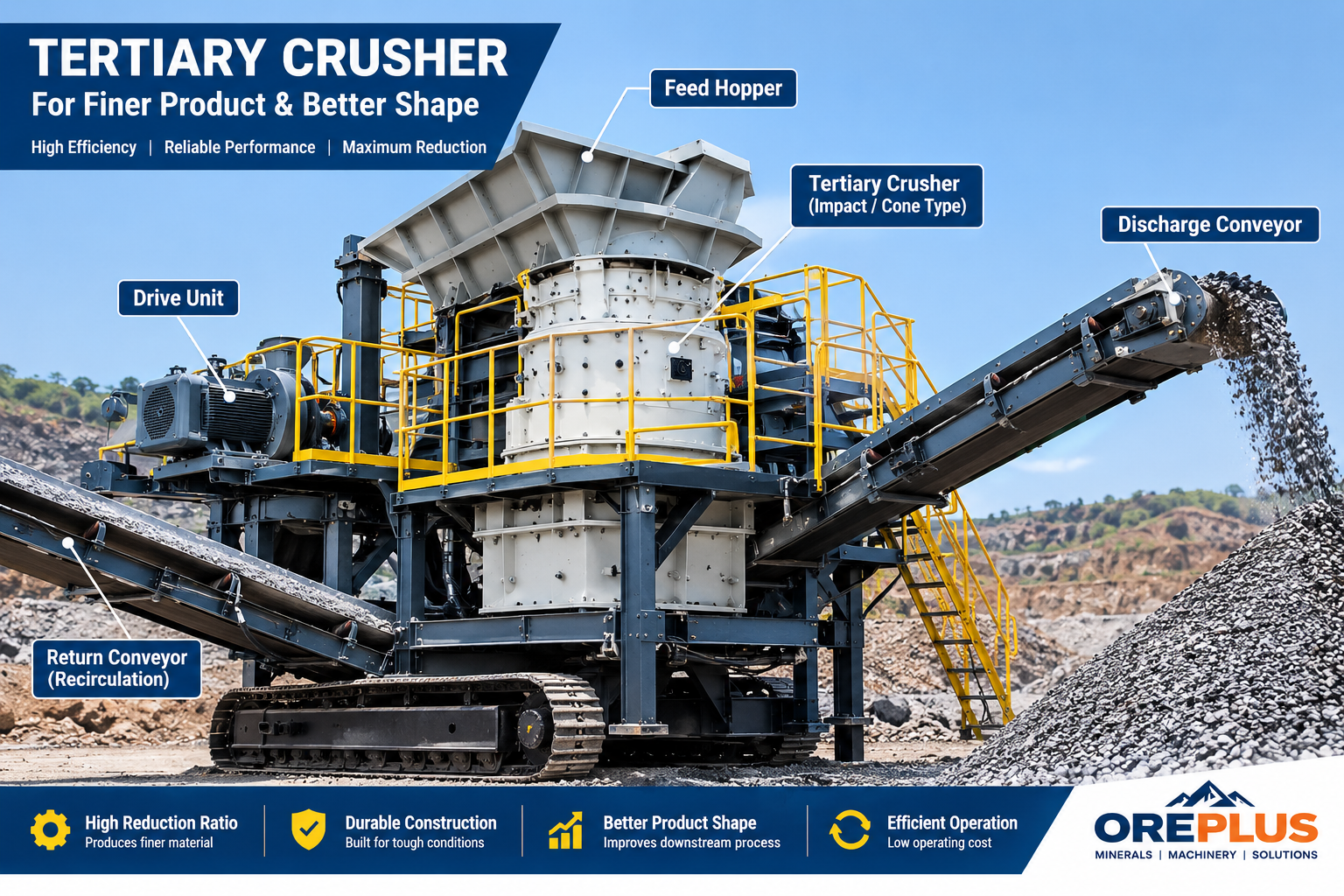
What is a Tertiary Crusher?
A tertiary crusher is the third stage in a multi-stage crushing circuit, following primary and secondary crushers. These machines utilize compression crushing action to further reduce material that has already been sized by secondary crushers, producing the final product specification typically ranging from ¼ inch to 10 mesh.
Common tertiary crusher types include cone crushers, vertical shaft impact crushers (VSI), and high-pressure grinding rolls. Each type offers distinct advantages depending on the mineral characteristics and desired final product.
Tertiary Crusher Applications in Mineral Processing
Iron Ore Processing
Tertiary crushers play a crucial role in iron ore beneficiation, producing finely ground material suitable for pelletization and direct reduction processes. The precision sizing achieved by tertiary crushing improves pellet quality and reduces energy consumption in downstream processes.
Bauxite Processing
In bauxite processing, tertiary crushers ensure consistent particle size distribution, which is essential for the Bayer process. The controlled product size enhances alumina extraction efficiency and reduces chemical consumption.
Coal Processing
Coal beneficiation plants rely on tertiary crushers to produce uniform coal particles, improving combustion efficiency and reducing emissions. The final sizing stage optimizes coal preparation for thermal and metallurgical applications.
Bentonite Processing
Bentonite clay processing requires precise particle sizing for optimal rheological properties. Tertiary crushers achieve the necessary fineness while preserving the clay's natural characteristics and mineral composition.
Key Benefits of Tertiary Crushers
Enhanced Product Quality
- Precise Size Control: Achieves consistent particle sizing within ±2% tolerance
- Improved Surface Characteristics: Produces cubical particles with minimal fines
- Uniform Distribution: Delivers narrow size distribution curves
Operational Efficiency
- Reduced Energy Consumption: Optimizes comminution energy by 15-25%
- Increased Throughput: Handles 300-500 TPH depending on configuration
- Lower Wear Costs: Utilizes durable wear parts with extended service intervals
Economic Advantages
- Capital Cost Efficiency: Lower initial investment compared to alternative grinding technologies
- Maintenance Savings: Reduced downtime and lower maintenance expenses
- Scalability: Modular design allows for easy expansion and upgrades
Typical Production Capacity
Standard Configurations
Modern tertiary crushing plants typically achieve production capacities ranging from 200 to 1,000 TPH (tons per hour), depending on the ore characteristics and desired final product specification.
Case Study: Granite Crushing Plant
A notable example is the 5.3 million-tonne granite crushing plant in Hainan, which demonstrates that high output depends on process coordination rather than single oversized equipment. The configuration includes GC200 jaw crushers for primary crushing and DS and HPY cone crushers for secondary and tertiary reduction duties.
Equipment Specifications
- Cone Crushers: 400-800 TPH capacity, 100-300 HP motor power
- Vertical Shaft Impact Crushers: 150-400 TPH capacity, 150-500 HP motor power
- High-Pressure Grinding Rolls: 100-300 TPH capacity, 200-600 HP motor power
Cost Analysis and Investment
Capital Expenditure
Tertiary crushing systems typically require capital investment ranging from $500,000 to $3 million, depending on capacity and technology selection. The modular nature of modern systems allows for phased implementation and cost-effective scaling.
Operating Costs
- Energy Consumption: 0.05-0.15 kWh/ton of processed material
- Wear Parts: $0.02-0.08 per ton of material processed
- Maintenance: 2-4% of capital cost annually
- Labor: 3-5 skilled operators per shift
Return on Investment
Most tertiary crushing projects achieve payback periods of 2-4 years, driven by improved product quality, reduced energy consumption, and lower maintenance costs compared to alternative processing methods.
Recent Technology Advancements
Automation Integration
Modern tertiary crushers feature advanced automation systems that monitor crusher performance, optimize settings, and predict maintenance requirements. These systems achieve 95% equipment availability and 20% energy savings.
Wear Part Innovations
Developments in wear-resistant materials, such as high-chromium alloys and ceramic inserts, extend wear part life by 30-50% and reduce replacement frequency from 6-12 months to 12-24 months.
Energy Efficiency
New motor technologies and variable speed drives optimize energy consumption, reducing power requirements by 10-15% while maintaining or improving production capacity.
Selecting the Right Tertiary Crusher
Material Characteristics
- Hardness: Mohs hardness 5-8 for most applications
- Abrasion Index: 0.3-0.6 for optimal crusher selection
- Moisture Content: Below 8% for dry crushing applications
Production Requirements
- Desired Product Size: ¼ inch to 10 mesh
- Throughput: 200-1,000 TPH
- Power Availability: 100-600 HP
Operational Considerations
- Site Constraints: Space limitations and environmental regulations
- Maintenance Capabilities: Available technical expertise and service support
- Budget Constraints: Initial investment and ongoing operating costs
Future Trends in Tertiary Crushing
The tertiary crushing sector is witnessing significant innovation, including the integration of artificial intelligence for process optimization, development of eco-friendly crushing technologies, and emergence of compact, mobile crushing solutions for remote mining operations.


 Posts
Posts


