OrePlus
Iron Ore Fines & Lumps Supplier — India
www.oreplus.in
1. Material Identification
| Material | Iron Ore Lumps |
| Fe Content | 50% – 52% |
| SiO₂ (Silica) Content | 8% – 15% |
| Size Range | 6.3 mm – 30 mm |
| Quantity | 50,000 MT |
| Origin | Goa, India |
2. What Is the Decrepitation Index (DI)?
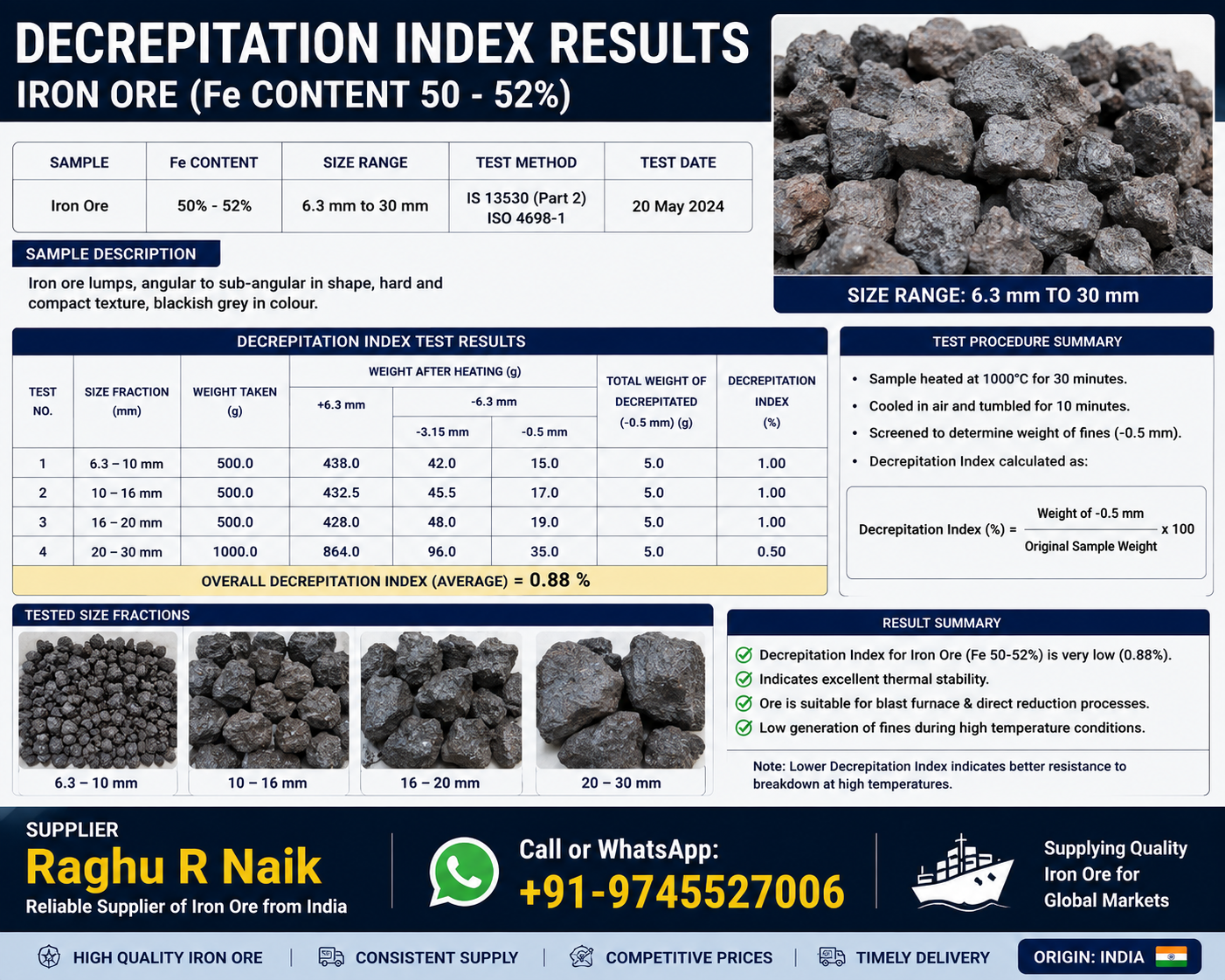
The Decrepitation Index (DI) is a metallurgical test parameter that measures the tendency of iron ore lumps to physically break down (thermally shatter) into fines when subjected to rapid heating, such as occurs during charging into a blast furnace or rotary kiln (DRI/sponge iron process). A lower DI value indicates better thermal stability — the ore retains its lump size and resists fines generation under thermal shock, which is important for maintaining good gas permeability and reduction efficiency inside the furnace bed.
3. Standard Test Method Reference
| Standard | Title / Scope |
|---|---|
| ISO 8371 | Iron ores for blast furnace and direct reduction feedstocks — Determination of the decrepitation index |
| IS 11312 (Indian equivalent, where applicable) | Methods for determination of decrepitation index of iron ore lumps |
The test procedure generally involves heating a sized, weighed sample of ore lumps to approximately 550°C, holding at that temperature for a specified period, then rapidly cooling/quenching and screening the sample. The percentage of material passing a defined lower screen size (commonly -6.3 mm or -3.15 mm depending on the standard used) relative to the original sample weight is reported as the Decrepitation Index (%).
4. Decrepitation Index — Result
| Parameter | Value | Remarks |
|---|---|---|
| Decrepitation Index (DI), % | To Be Confirmed by Accredited Laboratory Test | See Section 5 |
| Test Temperature | 550°C (typical, as per ISO 8371) | Confirm against method used by testing lab |
| Screen Size Used for DI Calculation | -6.3 mm (typical for lump ore per applicable standard) | Confirm against method used by testing lab |
| Sample Basis | Representative lot sample, Fe 50-52%, SiO₂ 8-15%, size 6.3-30mm | As identified in Section 1 |
5. Recommended Next Steps to Obtain a Verified DI Value
- Draw a representative sample from the 50,000 MT lot following standard iron ore sampling procedure (e.g., ISO 3082 / IS 1405).
- Submit the sample to an accredited/NABL-certified (or mutually agreed) metallurgical testing laboratory.
- Request testing per ISO 8371 (or IS 11312), specifying the applicable screen size and temperature parameters.
- Share the buyer's specific DI acceptance threshold, if any, so results can be benchmarked against contract requirements.
- Update this data sheet with the verified test certificate reference number and result once available.
6. General Guidance on Typical Industry DI Ranges
As general industry context only (not a substitute for actual testing): iron ore lumps with good thermal stability for blast furnace use are typically sought with a lower DI (commonly cited target ranges of roughly below 5-10% (-6.3mm generation) are considered favourable in many blast furnace specifications), while ores with higher goethitic/limonitic mineral content — which can be more common in certain lateritic ore-bearing regions — may show comparatively higher DI values due to structural water loss and internal cracking during heating. Because Goa's iron ore deposits include both hematite and goethitic/lateritic ore types, DI can vary between lots even within the same Fe and SiO₂ range, which is precisely why lot-specific laboratory testing is recommended rather than relying on a generic figure.


 Posts
Posts


