
Iron Ore Waste Dump Management & Processing in India — Goa Fe 45% to Fe 56% Recovery
Professional iron ore waste dump management and reprocessing services in India, specialising in Goa iron ore dumps — recovering usable iron ore grades from Fe 45% to Fe 56% with low silica and alumina content, processed using modern crushing and screening machinery including 200 TPH crushers and mobile screens, and supplied to domestic and export markets.
India, and particularly the state of Goa, holds large volumes of accumulated iron ore waste dumps generated from decades of mining activity. These dumps contain significant quantities of recoverable iron ore fines and lumps that, through proper waste dump management and reprocessing, can be upgraded into usable grades ranging from Fe 45% to Fe 56%, often with naturally low silica and alumina content suitable for both domestic steel plants and export to importing countries where demand for such grades remains consistently high.
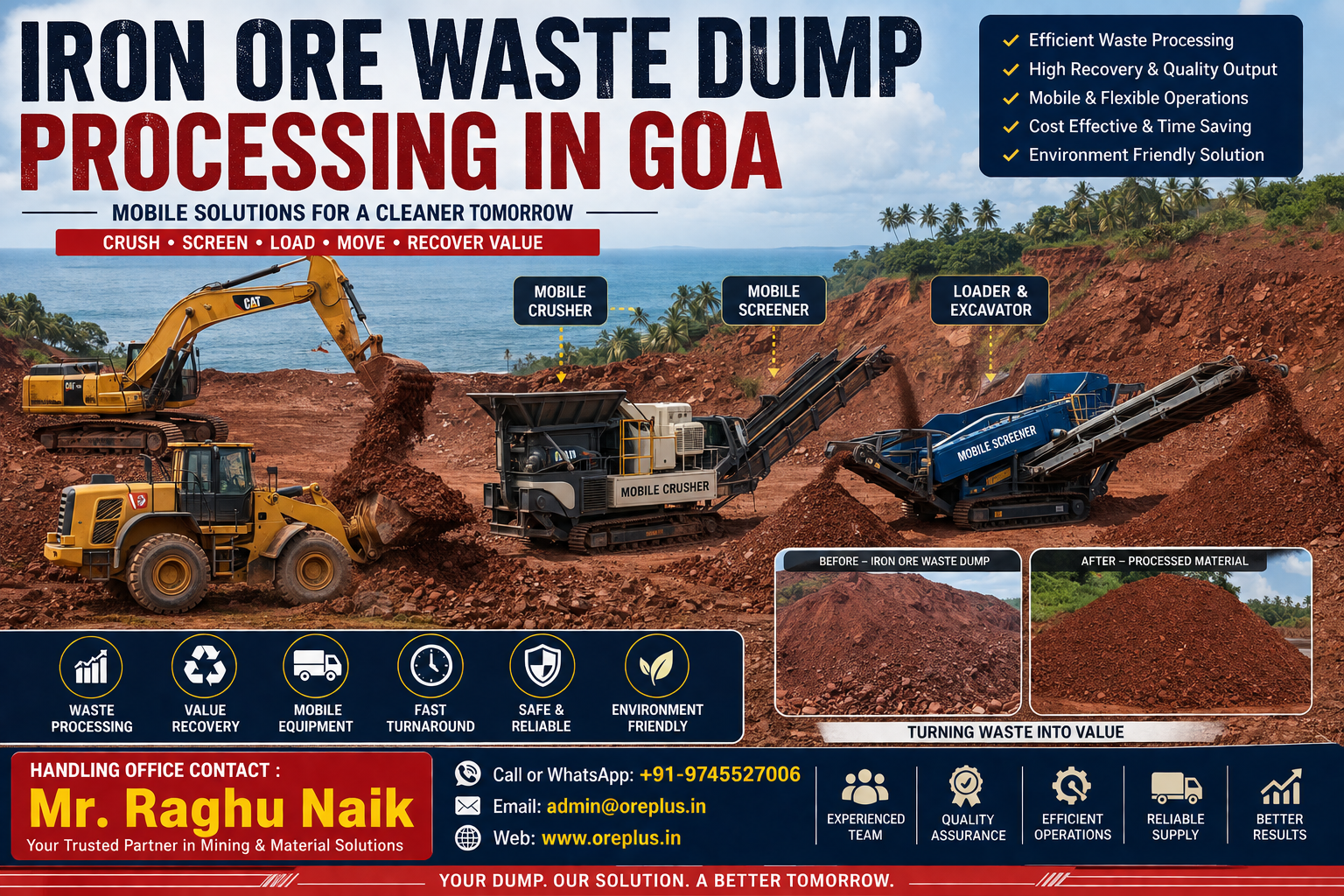
About Iron Ore Waste Dump Management in Goa, India
Historic iron ore mining operations in Goa generated substantial waste dumps consisting of low-grade ore, rejects, and overburden material that were set aside during earlier mining and beneficiation processes. With advances in crushing, screening and beneficiation technology, a meaningful proportion of the iron content in these legacy dumps can now be economically recovered. Proper waste dump management not only unlocks this recoverable ore value but also supports environmental remediation of old mining sites by systematically processing and clearing accumulated stockpiles.
Iron Ore Dump Processing — Step-by-Step
Dump Survey & Sampling
Initial assessment of the waste dump volume, ore distribution, and representative sampling to determine Fe content, silica, alumina and moisture levels before processing begins.
Excavation & Material Handling
Controlled excavation of dump material using excavators and loaders, with segregation of oversize rock, rejects and recoverable ore-bearing material.
Primary Crushing
Feeding of excavated material into a high-capacity crusher (typically 200 TPH and above) to reduce oversize lumps to a manageable, uniform size for downstream processing.
Screening & Size Classification
Mobile and stationary vibrating screens separate crushed material into different size fractions (fines, lumps and rejects), allowing each fraction to be processed or graded appropriately.
Beneficiation / Washing
Washing and scrubbing to remove clay, silica-rich fines and low-value gangue material, improving the overall Fe content and reducing silica/alumina levels in the processed ore.
Gravity / Magnetic Separation (as applicable)
Where required, gravity separation or magnetic separation techniques are used to further concentrate iron content and separate low-grade rejects from higher-grade recoverable ore.
Dewatering & Stockpiling
Processed material is dewatered and stockpiled by grade, ready for quality testing, blending and final dispatch.
Quality Testing & Grading
Final lab testing confirms Fe content, silica, alumina, moisture and size distribution, allowing material to be graded into saleable Fe 45%–56% categories.
Recoverable Iron Ore Grades from Goa Waste Dumps
| Grade Range | Silica (SiO₂) | Alumina (Al₂O₃) | Typical Use |
|---|---|---|---|
| Fe 45% – 48% | Low | Low | Sinter feed, blending material |
| Fe 48% – 52% | Low | Low | Sinter/pellet feed, domestic steel plants |
| Fe 52% – 56% | Low | Low | Sinter/pellet feed, export-grade material |
A key advantage of iron ore recovered from Goa's waste dumps is its naturally low silica and alumina content compared to many other sources, which improves its suitability for both domestic sinter/pellet plants and international buyers seeking cleaner-grade fines for blast furnace and DRI/sponge iron applications.
Machinery Used for Waste Dump Processing
⚙️ 200 TPH Crusher
High-capacity impact/jaw crusher unit for primary size reduction of excavated dump material, processing up to 200 tonnes per hour and above.
📏 Mobile Screens
Track-mounted mobile vibrating screens for on-site size classification, enabling flexible deployment across multiple dump locations without fixed infrastructure.
🪨 Grizzly Feeder
Controlled, uniform feeding of raw dump material into the crusher while pre-screening oversize and fines.
🔁 Conveyor System
Belt conveyors linking excavation, crushing, screening and stockpile stages for continuous material flow.
💧 Washing / Scrubbing Plant
Wet processing equipment to remove clay and fine silica content, improving Fe grade of the final product.
🚜 Excavators & Loaders
Heavy earthmoving equipment for dump excavation, material handling and stockpile management.
Export Suitability & Market Demand
Reprocessed iron ore fines recovered from Goa's dumps, particularly in the Fe 52%–56% range with low silica and alumina, are well suited for export to iron ore importing countries, where consistent, cleaner-grade fines are in steady demand for sinter and pellet feed. Domestically, these grades are also actively sought by Indian sinter and DRI/sponge iron plants as a cost-effective supplementary feedstock alongside freshly mined ore.
Why Choose Us for Iron Ore Waste Dump Management
- End-to-End Processing: From dump survey to final graded, dispatch-ready material.
- Goa Iron Ore Expertise: Focused experience in Goa's legacy iron ore dump characteristics.
- Modern Machinery: 200 TPH crushers, mobile screens and washing plants for efficient recovery.
- Export-Ready Grades: Fe 45%–56% output with naturally low silica and alumina content.
- Environmental Benefit: Systematic dump clearance supports remediation of legacy mining sites.
Frequently Asked Questions
- What iron ore grades can be recovered from Goa's waste dumps?
- Recoverable grades typically range from Fe 45% to Fe 56%, generally with low silica and alumina content.
- What machinery is used for processing the waste dumps?
- Processing uses excavators, a 200 TPH (and above) crusher, grizzly feeders, mobile and stationary screens, conveyor systems, and washing/scrubbing plants as required.
- Is the recovered iron ore suitable for export?
- Yes, particularly the Fe 52%–56% grades with low silica and alumina, which are in demand among iron ore importing countries as well as domestic sinter/pellet plants.
- Does dump processing help with environmental remediation?
- Yes, systematic processing and clearance of legacy waste dumps supports remediation of old mining sites while recovering economic value from the material.
Enquire About Iron Ore Waste Dump Management & Recovered Ore Supply
Fe 45% – Fe 56% Grades • Low Silica & Alumina • Export & Domestic Supply
Contact Person: Mr. Raghu Naik
📞 Call: +91-9745527006 💬 WhatsApp: +91-9745527006 🌐 www.oreplus.inContact Person: Mr. Raghu Naik
Service: Iron Ore Waste Dump Management & Processing — Goa, India — Fe 45% to Fe 56% Recovery
Call / WhatsApp: +91-9745527006
Website: www.oreplus.in


 Posts
Posts


